Medically reviewed by the clinical team at Immediate Care Center of Westmont · Published July 23, 2026 · Last reviewed July 23, 2026
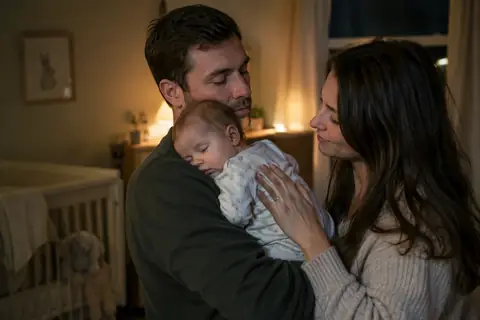
A fever in a newborn or very young baby is one of the few situations where the usual “watch and wait” advice does not apply. At Immediate Care Center of Westmont, our walk-in clinic in Westmont, IL, we want every parent in DuPage County to know one clear, potentially life-saving rule: any baby under 3 months old with a temperature of 100.4°F (38°C) or higher needs emergency medical evaluation right away. This guide explains why young infants are different, how to take an accurate temperature, and exactly what to do when your baby feels warm.
Emergency rule for babies under 3 months: A rectal temperature of 100.4°F (38°C) or higher is a medical emergency. Do not give fever medicine and wait to see what happens. Call your pediatrician immediately or go to the nearest emergency room. This is not a situation for home remedies or an urgent care visit — a young infant with a fever needs prompt hospital-level evaluation.
Why Young Babies Are Treated So Differently
In an older child, a fever is usually a reassuring sign of a healthy immune system fighting a common virus. In a baby under 3 months, the immune system is still immature and cannot wall off infections the way an older child’s can. That means a serious bacterial infection — of the blood, urine, lungs, or the fluid around the brain and spinal cord — can take hold quickly, and a fever may be the only outward clue. A young baby may not show the localized symptoms (like a cough or an obvious sore throat) that would point to the source in an older child.
Because the stakes are high and the warning signs are subtle, doctors take an aggressive, cautious approach. Newborns and young infants with a fever typically need a thorough workup — often including blood, urine, and sometimes spinal fluid testing — that can only be done in a hospital or emergency setting. Acting early gives your baby the best possible outcome.
How to Take Your Baby’s Temperature Accurately
Read moreClose
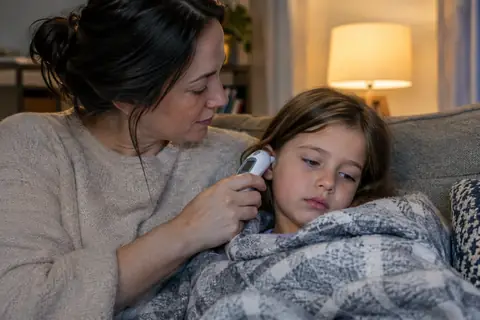
For infants, accuracy matters, and a rectal temperature is the gold standard and the reading doctors rely on for this age group. Forehead and ear thermometers can be useful for screening but are less reliable in newborns. If you get a high forehead reading in a young baby, confirm with a rectal thermometer if you can — but if your baby is clearly warm and you cannot, do not delay seeking care while troubleshooting the device.
Use a clean digital thermometer designated for rectal use, with a small amount of lubricant
Insert only about a half-inch and hold gently until it reads
Never use a glass mercury thermometer
Note the exact number and the time so you can report it to the medical team
Also be aware that a temperature that is too low (hypothermia) in a young baby can be just as concerning as a fever and also warrants urgent evaluation.
Ages 3 to 6 Months: Still Cautious
Read moreClose
Between 3 and 6 months of age, babies are still developing their defenses, and fever deserves close attention. Contact your pediatrician promptly for a fever in this age range, and seek care the same day if the temperature reaches 102°F or higher, if the fever lasts more than a day, or if your baby seems unwell in any way. Our pediatric urgent care team can help you evaluate these older infants, and we will always direct you to emergency care if your baby needs a higher level of evaluation.
Warning Signs That Demand 911 or the ER
Read moreClose
Call 911 or go to the nearest emergency room immediately if your baby has any of the following, at any temperature:
Any fever of 100.4°F or higher in a baby under 3 months
Trouble breathing, rapid or grunting breathing, or bluish lips or skin
A bulging soft spot on the head, or a stiff neck
A seizure
Being very difficult to wake, extremely floppy or limp, or unresponsive
Persistent vomiting or refusing to feed
Signs of dehydration: far fewer wet diapers, no tears, a dry mouth, or a sunken soft spot
A purple or red rash that does not fade when pressed
Inconsolable, high-pitched, or unusual crying that you cannot soothe
Trust yourself. If your baby simply does not seem right, that instinct is worth acting on. It is always better to have a young infant evaluated and reassured than to wait.
What Not to Do
Read moreClose
Do not give fever medication to a baby under 3 months unless a doctor has specifically told you to. Lowering the number can mask a fever without treating the cause, and the safest step is evaluation, not medication.
Do not give any medication to bring down a fever and then “wait to see” in this age group.
Do not use cold baths, ice, or rubbing alcohol to cool your baby — these can cause harm.
Do not overbundle a warm baby, which can trap heat.
Never give aspirin to a baby or child.
What to Expect During Evaluation
Read moreClose
If your young baby has a fever, the medical team will act quickly and thoroughly. Depending on your baby’s age and how they look, testing may include a urine sample, blood tests, a chest X-ray, and sometimes a spinal fluid sample to rule out serious infection. Many young infants are observed in the hospital while results come back. This careful approach is standard and protective — it reflects how seriously the medical community treats fever in the youngest babies, not that something catastrophic is necessarily happening.
We Are Here to Help Your Family
Read moreClose
Immediate Care Center of Westmont is a walk-in clinic serving DuPage County families, with two Westmont locations, an on-site lab, and digital X-ray. For older babies and children, our pediatric urgent care and urgent care teams can evaluate fevers and common illnesses quickly. We are open Monday through Friday, 9 AM to 6 PM, and Saturday and Sunday, 9 AM to 5 PM. Call (630) 324-6825 or check in online. Review our cost and insurance information any time. But for any baby under 3 months with a fever, do not wait for us — call your pediatrician or head to the ER right away.
This page is for general educational purposes and is not a substitute for professional medical advice. If you are experiencing a medical emergency, call 911.
My baby just had vaccinations and now has a low fever. Is that different?
Mild fever can follow immunizations. Still, for a baby under 3 months, a temperature of 100.4°F or higher should prompt a call to your pediatrician right away — do not assume it is only from the shots. Let the doctor decide.
Could my baby just be too warmly dressed?
Overbundling can raise skin temperature. Unbundle your baby, wait a short time, and recheck with a rectal thermometer. If it is still 100.4°F or higher, treat it as an emergency and seek care.
Should I go to urgent care or the ER for my newborn’s fever?
For a baby under 3 months with a fever, the emergency room (or immediate direction from your pediatrician) is the right choice, because these infants often need hospital-based testing. Our urgent care team is glad to guide you, but we will send a feverish young infant to the ER for the appropriate workup.
What number counts as a fever in a baby?
A rectal temperature of 100.4°F (38°C) or higher is a fever at any age — and in a baby under 3 months, that number is a medical emergency.
“I had a laceration that was stitched in ten minutes and was out of there in thirty minutes! No pain the next day. Meds are working! Professional staff all around.”
Jack M. · March 2026 · Google★★★★★
“Alexa, Kelly, and the young man in the front desk are very kind! This is the first time everyone from a clinic is treating me with honest concern and kindness! Thank you all!!! God bless.”
Maricarmen C. · January 2026 · Google★★★★★
“Very friendly and helpful service! They were packed with it being holiday time, but they were very efficient.”