

Almost nobody knows when their last tetanus shot was. It is one of the most common exchanges in a walk-in clinic: someone arrives with a cut, a bite, or a burn, gets asked the date of their last booster, and answers “sometime in college, maybe?”
That answer is fine. There is a standard way clinicians handle an unknown date, and it does not involve guessing. This guide explains how the decision is actually made, so you know what to expect before you come in.
Clostridium tetani lives in soil, dust and manure. It is not passed between people. Its spores enter through broken skin and, in a low-oxygen environment — which is exactly what a deep puncture provides — they produce a toxin that causes severe, sustained muscle spasms, including of the jaw and the muscles used to breathe.
It is rare in the United States because vaccination is widespread, not because the bacteria have gone anywhere. The CDC’s tetanus overview is a good plain-language reference. The reason clinics are attentive about boosters is that there is no cure once the toxin has bound — treatment is supportive, and prevention is the whole strategy.
This is the part worth knowing, because it explains why the answer changes depending on the wound.
| Wound type | Examples | Booster recommended if your last one was… |
|---|---|---|
| Clean and minor | A shallow kitchen knife cut, a paper cut, a clean scrape | 10 or more years ago |
| All other wounds | Punctures, animal and human bites, burns, crush injuries, anything contaminated with soil, saliva, or debris; frostbite | 5 or more years ago |
That five-year line is why someone who had a booster six years ago and thought they were covered still gets offered one after standing on a nail. Routine adult vaccination runs on a ten-year cycle; wound management runs on five for anything dirty.
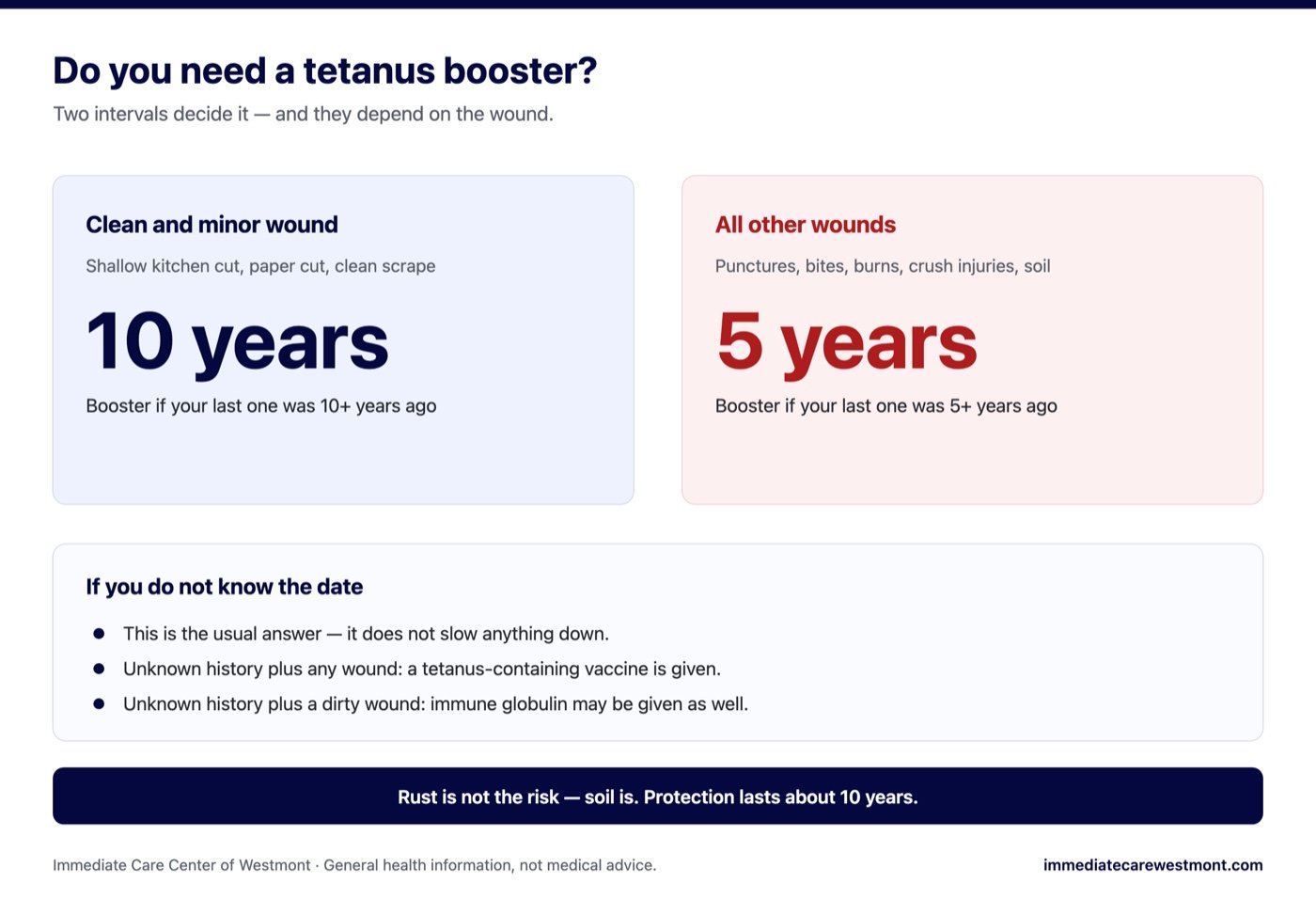
This is the normal case, not the exception, and there is a defined approach:
Anyone born in the US after the 1940s who attended school almost certainly completed a childhood series. The uncertainty is nearly always about the adult booster, not the primary series.
Yes, and it is usually worth taking the one that covers more.
Current guidance allows either for wound management, and Tdap is often preferred if you have never had one as an adult — particularly if you are around infants, who are the group most seriously harmed by pertussis. Pregnancy has its own schedule: Tdap is recommended in every pregnancy, usually between 27 and 36 weeks, to pass protection to the newborn. The CDC publishes the full adult immunization schedule.
Protection from a booster lasts about ten years, which is why the routine adult interval is set there. The injection itself is unremarkable; the arm is typically sore for a day or two, and some people get mild fatigue or a low-grade temperature. Serious reactions are rare. If you have had a severe reaction to a previous tetanus-containing vaccine, say so — that genuinely changes the plan.
The National Library of Medicine’s MedlinePlus tetanus page is a useful plain-language second reference.
In practice these are the ones that come up:
You do not need an appointment or an injury. Immediate Care Center of Westmont provides tetanus boosters as part of routine immunizations at both Westmont locations, seven days a week — whether you have a wound to treat or simply want to be current before a trip, a new job, or a summer of yard work.
If you do have a wound, the booster is given as part of treating it rather than as a separate visit.
Sooner is better, and same-day is the goal, but it is still worth getting if a few days have passed. If your vaccination history is incomplete and the wound is dirty, timing matters more — that is the situation where immune globulin may also be needed, and it works best given early.
Almost certainly not. Two years is well inside both the five-year and ten-year windows. Tell the clinician the date and it will be recorded rather than repeated.
Rust is not the risk — soil is. A rusty nail is dangerous because it has usually been lying in dirt, and because a nail makes a deep, narrow puncture. A clean new nail driven into your foot in a garden carries a similar risk.
If there is visible dirt or gravel in it, yes. Road rash and yard-work abrasions are routinely treated as tetanus-prone, especially when they cannot be cleaned out completely.
Often, yes. Illinois maintains an immunization registry, and your primary care office, a previous employer’s occupational health file, or a school or college health service may have it. If you can find the date before you come in, bring it — it saves a decision. If you cannot, that is genuinely fine.
Not knowing is the usual answer, and it does not slow anything down. Immediate Care Center of Westmont takes walk-ins seven days a week at both Westmont locations for wound care and for boosters on their own.
Check in online or call (630) 324-6825 — and if you are insured, it is worth confirming your plan is accepted first. If you have a wound with spreading redness, a red streak tracking up the limb, difficulty opening your jaw, or muscle stiffness in the neck or abdomen, seek emergency care immediately.
This article is general health information, not medical advice. It cannot account for your history, medications, or examination. If you think you are having a medical emergency, call 911.
Monday – Friday: 9:00 AM – 6:00 PM
Saturday – Sunday: 9:00 AM – 5:00 PM

These settings are saved on this device only.