
Burns are one of the few injuries where people consistently underestimate what they are looking at. A burn that blisters is not a minor burn, and a burn that stopped hurting is not a good sign. Both are common reasons someone waits at home longer than they should.
This guide covers what the different burn depths actually look like, which burns a walk-in clinic can treat properly, and the specific features that mean an emergency department or a burn centre instead.
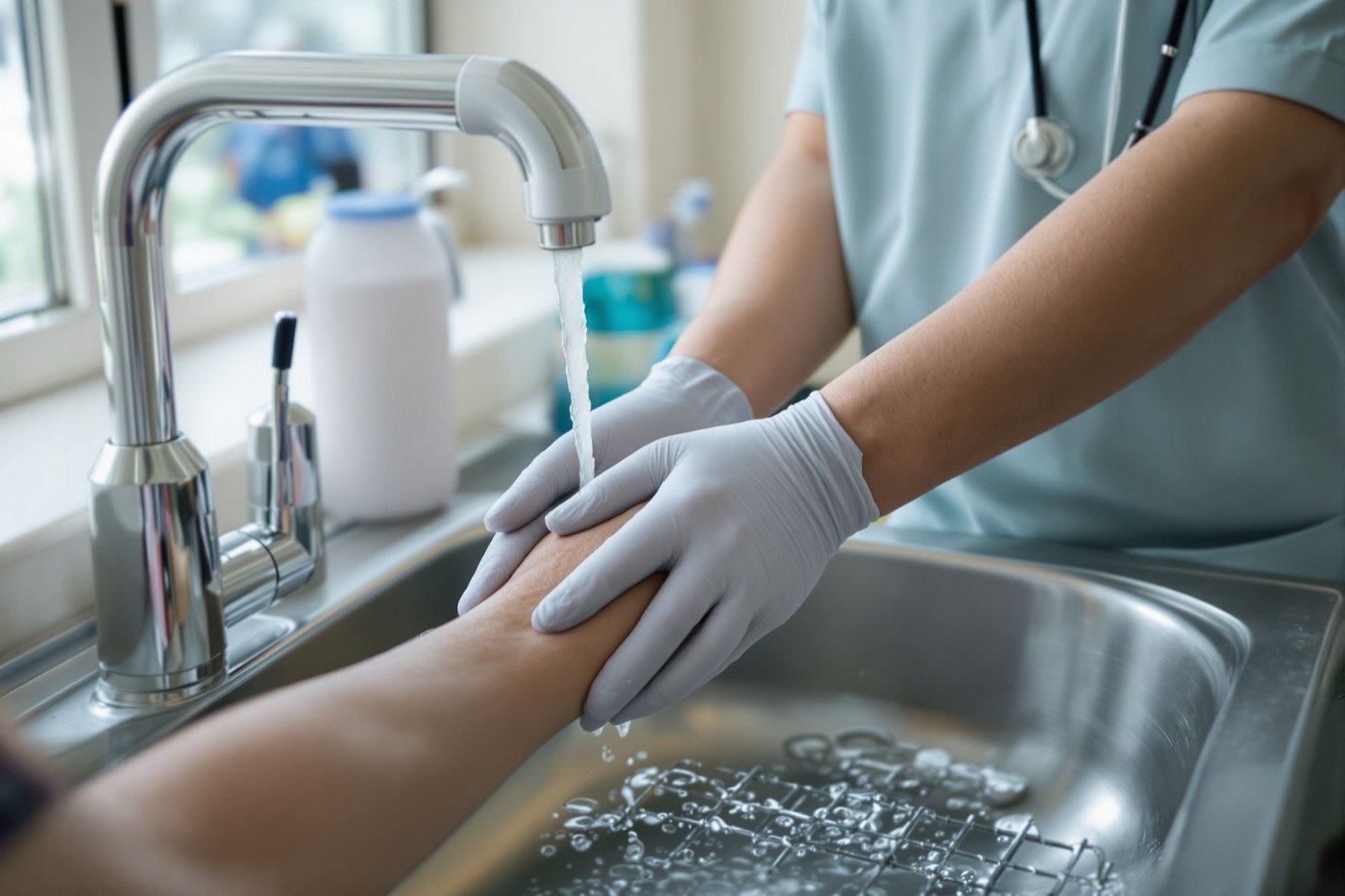
What you do immediately affects how deep the burn ends up being. Heat keeps working in the tissue after the source is gone.
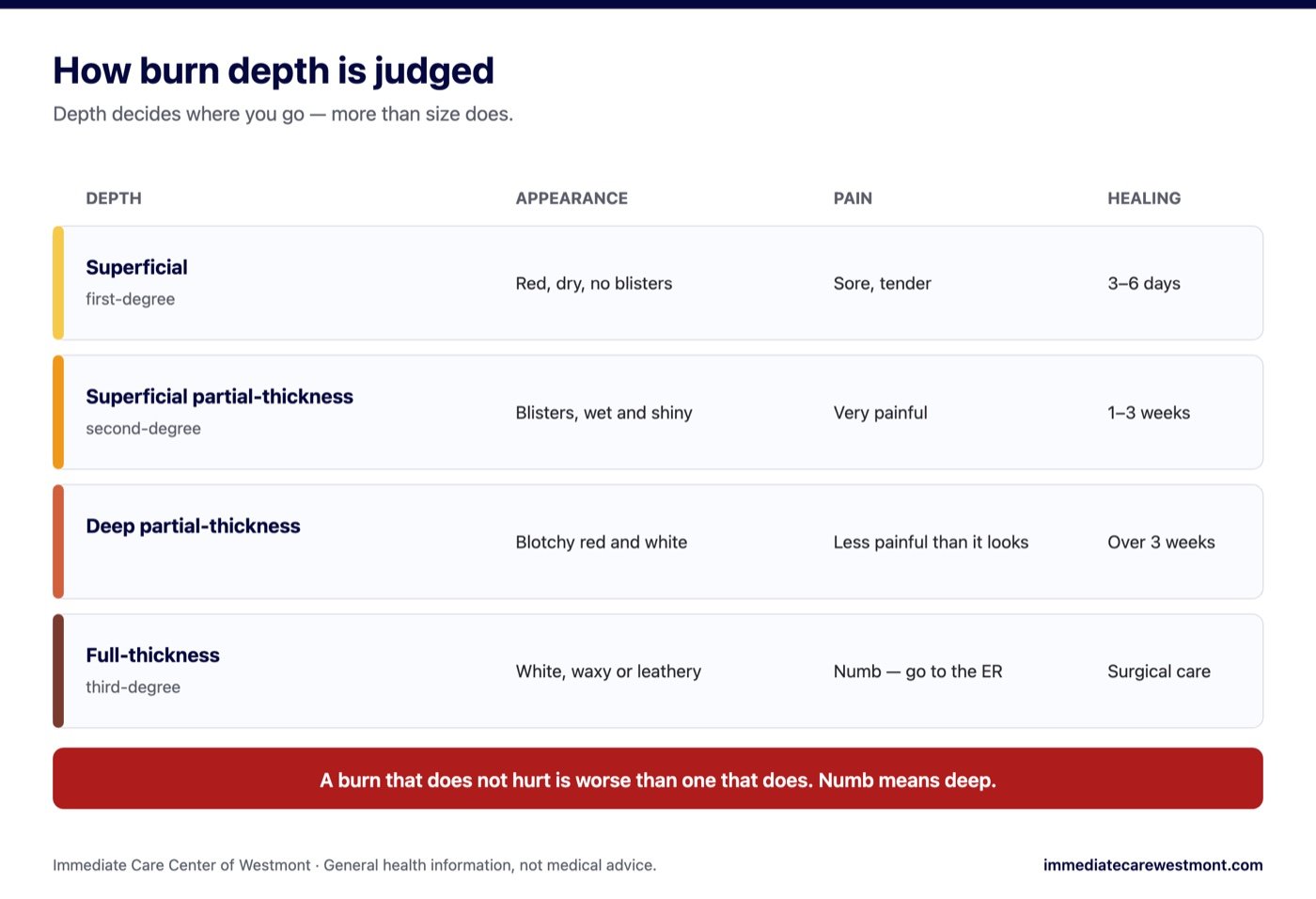
Depth matters more than size for deciding where to go, and it is judged mostly on appearance and sensation.
| Depth | What it looks like | Pain | Typical healing |
|---|---|---|---|
| Superficial (first-degree) | Red, dry, no blisters — like sunburn | Sore, tender | 3–6 days, no scar |
| Superficial partial-thickness (second-degree) | Blisters, wet and shiny underneath, blanches when pressed | Very painful | 1–3 weeks, usually no scar |
| Deep partial-thickness | Blotchy red and white, drier, slow to blanch | Less painful than it looks | Over 3 weeks, scarring likely |
| Full-thickness (third-degree) | White, waxy, leathery or charred | Numb — nerve endings destroyed | Requires surgical care |
The counterintuitive part: a burn that does not hurt is worse than one that does. Loss of sensation means the burn has gone deep enough to destroy the nerve endings in the skin. Painless, white or leathery skin is an emergency department finding, not a walk-in one.
Walk-in urgent care is well suited to small burns in low-risk locations: a splash from a pan, a brief contact with a hot oven rack, a curling-iron burn on the forearm. What a clinic adds is proper cleaning, a decision about blisters, a dressing that will not weld itself to the wound, a tetanus booster if you are due, and a scheduled look at it again in 48 hours — which is the part people skip and later regret.
Use the size of your own palm as the yardstick: your palm including fingers is roughly 1% of your body surface area.
The American Burn Association’s referral criteria are the standard clinicians use. In plain terms, go to an ER if any of these apply:
If you have been directed to a burn centre, the American Burn Association keeps a directory of verified burn centers by state.
This is a common and reasonable worry, and it is worth naming: being seen once does not mean the burn has finished evolving. Burns are notorious for declaring their true depth over the first 48 to 72 hours. A burn assessed as superficial partial-thickness on day one can look deeper on day three, and that is not a mistake — it is the injury maturing.
Come back for a wound check if:
A burn that has not healed within three weeks generally needs specialist review, because that timeline predicts scarring.
For a plain-language second reference on burn types and first aid, the National Library of Medicine’s MedlinePlus page on burns is reliable and readable.
Burns are treated as tetanus-prone wounds. If it has been five years or more since your last booster, expect one to be offered. Most people genuinely do not know when theirs was — our guide to whether you need a tetanus shot explains how that decision gets made when the date is unknown.
At Immediate Care Center of Westmont a burn visit means assessing depth and surface area, cleaning the wound, making a considered decision on blisters, applying a proper non-adherent dressing, managing pain, updating tetanus, and arranging a follow-up wound check — usually within 48 hours, which is when the burn will have told us what it really is. Minor burn treatment is a routine part of what both Westmont clinics do.
If your burn meets any of the emergency criteria above, we will say so and direct you rather than treat it. That is the correct outcome, and it is faster than being treated twice.
No. Intact blister skin protects the raw surface underneath and lowers infection risk. Clinicians sometimes de-roof very large or awkwardly placed blisters under sterile conditions, but that is a judgement made in the room, not at home.
Spreading redness beyond the burn edge, increasing rather than decreasing pain after 48 hours, pus, odour, or fever. Burns are open wounds and the warning signs are broadly the same ones described in our guide on what to do if a wound feels infected.
Usually not — most sunburn is superficial and self-limiting. It is worth being seen if the sunburn has blistered over a large area, or if it comes with faintness, vomiting, confusion or a high temperature, which point to heat illness rather than the burn itself.
We publish self-pay pricing rather than making people ask. See self-pay urgent care pricing, and if you are uninsured you are also entitled to a written Good Faith Estimate before treatment. If you do have insurance, check that we are in network with your plan before you travel.
Small, superficial burns in low-risk areas, yes. Burns in infants, larger burns, and burns to the hands or face in children are emergency department territory — children have thinner skin and burn deeper at the same temperature and exposure than adults do.
Cool it under running water for 20 minutes, cover it loosely, and get it looked at. Immediate Care Center of Westmont treats minor burns seven days a week at both Westmont locations, with follow-up wound checks built into the plan rather than left to chance.
Check in online or call (630) 324-6825. For a burn that is white or leathery, painless, circumferential, electrical, chemical, or on the face, hands, feet or genitals — go straight to an emergency department.
This article is general health information, not medical advice. It cannot account for your history, medications, or examination. If you think you are having a medical emergency, call 911.
Monday – Friday: 9:00 AM – 6:00 PM
Saturday – Sunday: 9:00 AM – 5:00 PM

These settings are saved on this device only.