

Most bites that come through our doors are not dramatic. A dog that was startled. A cat that had had enough. A hand that got between two animals sorting something out. The wound looks small, it has mostly stopped bleeding, and the question you are actually asking is whether this is worth anyone’s time.
It usually is — but not because of the bleeding. Bites are treated seriously because of what gets pushed under the skin, and because the risk is highest in exactly the wounds that look least impressive.
A bite is a puncture, not a cut. Teeth carry bacteria past the skin’s protective barrier and seal it in as the surface closes over. Pasteurella multocida, staph and strep species all live in the mouths of dogs and cats, and a tidy-looking puncture is the ideal environment for them.
That is why the numbers run the way they do. The Centers for Disease Control and Prevention estimates roughly 4.5 million dog bites happen in the United States each year, and around one in five needs medical attention. Cat bites are far less common but infect much more often, because a cat’s narrow teeth drive deep and leave a small opening that closes fast.
The single most useful thing anyone does for a bite is thorough irrigation — flushing the wound out properly. It is unglamorous and it does more to prevent infection than anything that comes after it.
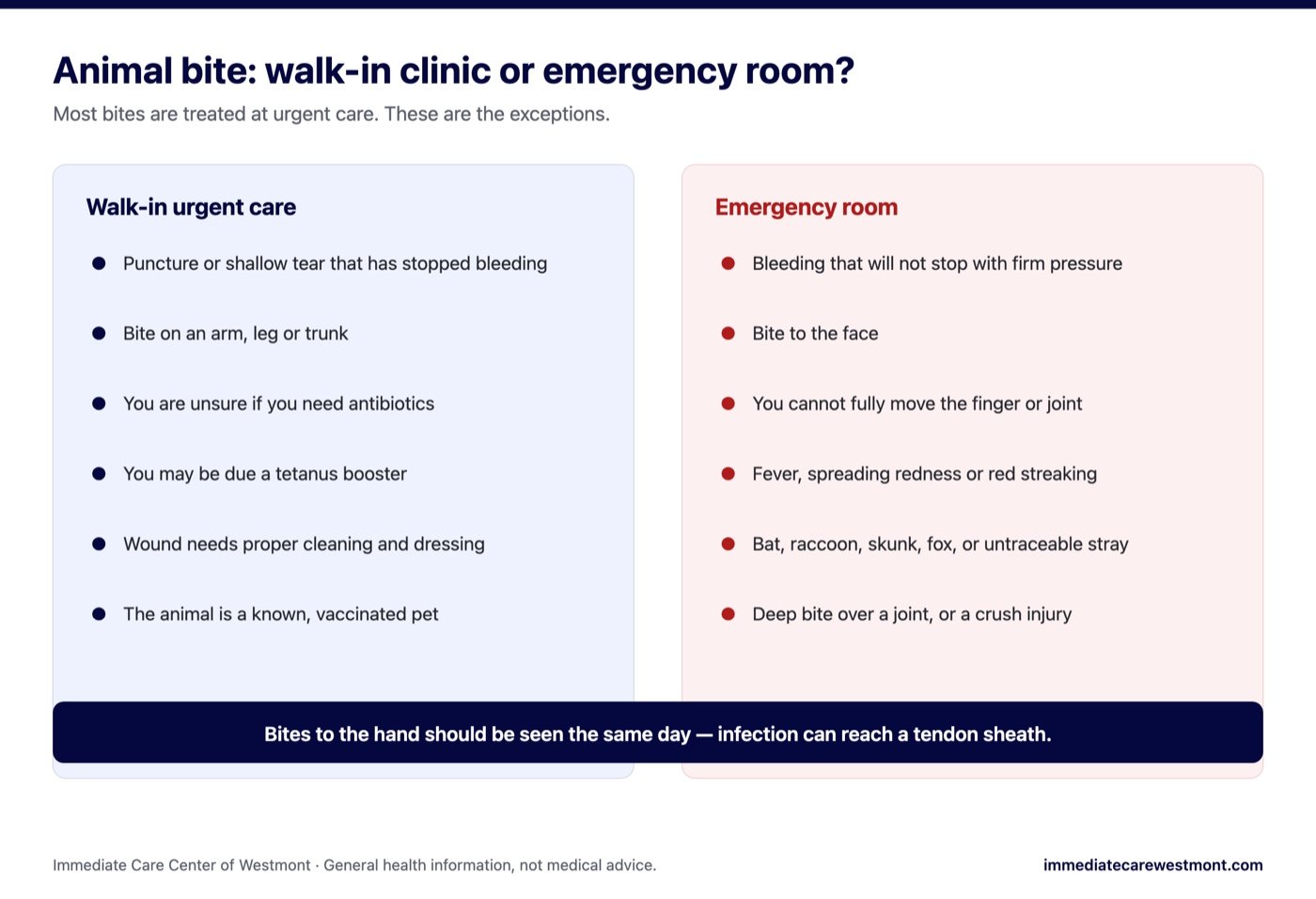
Walk-in urgent care is the right level of care for most bites. There are specific exceptions, and they are worth knowing before you decide.
| Walk-in urgent care is appropriate | Go to the emergency room |
|---|---|
| Puncture or shallow tear that has stopped bleeding | Bleeding that will not stop with firm pressure |
| Bite on an arm, leg, or trunk | Bite to the face, or any wound you would want a plastic surgeon to close |
| You are unsure whether you need antibiotics | You cannot fully move the finger, hand, or joint below the bite |
| You need a tetanus booster | Fever, spreading redness, or red streaking from the wound |
| Wound needs cleaning and a proper dressing | The animal was a bat, raccoon, skunk, fox, or a stray you cannot trace |
| The animal is a known, vaccinated household pet | Deep bite over a joint, or a crush injury from a large dog |
Hand bites deserve their own line. The hand has very little soft tissue between skin and tendon sheath, and an infection that reaches a tendon sheath is a surgical problem, not an antibiotics problem. Any bite to the hand — especially over a knuckle — should be looked at the same day.
Not every bite needs them. Clinicians generally do prescribe preventively for higher-risk wounds: cat bites, punctures, bites to the hand, foot, or face, bites in people whose immune systems are suppressed, and bites that are more than eight to twelve hours old by the time they are seen. Amoxicillin-clavulanate is the usual first choice because it covers the specific organisms that live in animal mouths.
A bite counts as a contaminated wound, which shortens the interval at which a booster is recommended. If it has been five years or more since your last tetanus shot, expect to be offered one. Most people cannot remember the date — that is normal, and it is covered properly in our guide to when you actually need a tetanus shot.
This is where the animal’s identity matters more than the wound. A healthy, vaccinated dog or cat that can be observed for ten days is a very different situation from a bat in the bedroom or a stray that ran off. Bats in particular warrant medical advice even without an obvious bite. The CDC maintains clear public guidance on rabies exposure, and in Illinois animal bites are reportable to the local health department — a step the clinic handles, not you.
The National Library of Medicine’s MedlinePlus overview of animal bites is a good plain-language second reference if you want to read further.
Bite infections tend to declare themselves within 24 to 48 hours. Come back — or go to an emergency room if it is severe — if you notice:
The same warning signs apply to any wound that breaks the skin. If you are watching a wound rather than a bite, our guides on when to worry about a cut and whether an infected cut needs urgent care go into more detail.
A bite visit at Immediate Care Center of Westmont is usually straightforward: history of the animal and the injury, a proper look at how deep it goes and whether anything underneath is involved, thorough irrigation, a decision on antibiotics, a tetanus booster if you are due, and a dressing. If there is any question about a fracture or a foreign body, we have on-site X-ray rather than sending you somewhere else for it.
We will also tell you plainly if you are in the wrong place. A bite that needs a hand surgeon or a wound that needs formal exploration is not something to attempt at a walk-in clinic, and being sent onward quickly is a better outcome than being treated slowly.
Sooner is meaningfully better. Irrigation and a decision on antibiotics are most effective in the first several hours. After roughly eight to twelve hours the infection risk rises enough that clinicians treat the wound differently. If a bite is already a day or two old and looks angry, that is still worth being seen for — it just changes the approach.
Often not, and that is deliberate. Many bite wounds are intentionally left open to drain, because closing a contaminated puncture traps bacteria. Facial wounds are a common exception, which is one reason they are usually handled in an emergency department.
Rabies risk is low in that situation, but bacterial infection risk is unchanged — that comes from the puncture, not the animal’s vaccination record. A bite to the hand, a deep puncture, or a wound in someone with diabetes or a suppressed immune system should still be seen.
Scratches are generally lower risk than bites because they are shallower, but deep scratches can still become infected and cat-scratch disease is a real, if uncommon, condition. Watch for spreading redness or a swollen lymph node near the scratch over the following one to two weeks.
If you are insured, it is worth confirming we are in network with your specific plan before you drive over — see how to check whether urgent care takes your insurance. If you are uninsured, our self-pay pricing is published.
No. We need to know what it was, whether it can be observed, and its vaccination status if you know it. If you do not know, say so — that is a common answer and it is handled routinely.
Wash it thoroughly, cover it, and come in. Immediate Care Center of Westmont sees walk-in patients seven days a week at both Westmont locations, and bite wounds are treated as same-day problems.
You can check in online before you arrive, or call (630) 324-6825 if you would rather talk it through first. If the bleeding will not stop, the bite is to the face, or you cannot move the joint below the wound, go to an emergency room instead.
This article is general health information, not medical advice. It cannot account for your history, medications, or examination. If you think you are having a medical emergency, call 911.
Monday – Friday: 9:00 AM – 6:00 PM
Saturday – Sunday: 9:00 AM – 5:00 PM

These settings are saved on this device only.