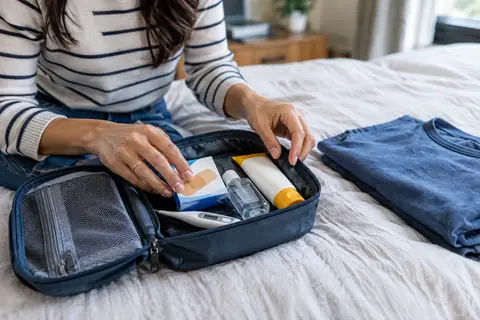
Pre-travel visits at Urgent Care Center of Westmont in Westmont, IL. We review your destination, vaccine history and health needs, and give advice on travelers' diarrhea, malaria prevention and staying safe abroad.
The CDC advises seeing a healthcare provider at least 4 to 6 weeks before international travel, because some vaccines need time to work or need more than one dose. Urgent Care Center of Westmont, also known as Immediate Care Center of Westmont, offers pre-travel visits for adults and children. We review your itinerary, activities and medical history and use CDC Travelers' Health guidance to plan your care.
Leaving soon? Come in anyway. The CDC notes that last-minute travelers can still benefit from a visit, even days before departure.
Key facts
Travelers' diarrhea affects roughly 30 to 70 percent of travelers over a 2-week trip, depending on the destination and season, per the CDC Yellow Book.
Oral rehydration salts mixed into boiled or treated water are the first step for travelers' diarrhea.
Some infections picked up abroad cause symptoms weeks after you get home, so always tell a clinician where you traveled.
Bring your vaccine records and medicine list to your pre-travel visit at Urgent Care Center of Westmont in Westmont, IL.
What a pre-travel visit covers
A review of your destination, length of stay and planned activities
A check of your routine vaccines and your records
Travel vaccines your trip may call for, such as typhoid, hepatitis A and hepatitis B
Advice on malaria prevention medicine if your destination has malaria risk
Advice on altitude sickness and travelers' diarrhea
Food and water safety, insect bite prevention and local health notices
Bring your vaccine records and a list of your medicines. Vaccine stock can change, so call (630) 324-6825 to confirm the vaccines you need are available.
Yellow fever vaccine and the yellow card
Some countries require proof of yellow fever vaccination on an International Certificate of Vaccination or Prophylaxis (the yellow card). In the United States, this vaccine is given only at clinics authorized to provide it. Call us before you come to ask about yellow fever vaccine, or use the CDC's yellow fever vaccination clinic search to find an authorized site.
How we help before and after your trip at our Westmont, IL clinic
Read moreClose
Our providers check the CDC destination page for your trip and tailor advice to your health. You leave with a plan for vaccines, medicines to discuss and a travel health kit. The CDC suggests packing enough prescription medicine for the whole trip plus extra, and checking whether your health insurance covers care abroad.
After you return, we can see you for fever, diarrhea, rash or other new symptoms. Tell the provider where you traveled, because some infections show up weeks after a trip.
Hours at both sites: Monday through Friday 9 AM to 6 PM, Saturday and Sunday 9 AM to 5 PM. Walk-ins are welcome, and online check-in lets you hold your place. Visit us at 29 N Cass Ave, Ste A, Westmont, IL, or at our Jewel-Osco location, 4 E Ogden Ave, Westmont, IL.
Our clinic works with most major insurers, such as Cigna, Humana, UnitedHealthcare, Multiplan/PHCS and Medicare. Call (630) 324-6825 to confirm that your plan covers travel vaccines and visits, or review our accepted insurance and costs.
Paying on your own? Read about our flat, upfront self-pay pricing, and ask us for the cost of any lab work before it is done.
Travelers' diarrhea: prevention and self-care
Read moreClose
Travelers' diarrhea is the most predictable travel illness, according to the CDC. Risk is higher where sanitation, safe water and refrigeration are limited. Young adults get it more often than older travelers.
Choose food with care. Street-vendor food raises the risk, and the CDC advises the same caution with food and water served on flights.
Pack oral rehydration salts. Mix one packet into about a liter of boiled or treated water, and sip often if diarrhea starts.
In mild cases, any drink you like, including sports drinks, can help. Avoid large amounts of very sugary drinks, which can make diarrhea worse.
Loperamide can ease symptoms, especially before a long bus ride or flight. Follow the label, and do not use it alone for bloody diarrhea or diarrhea with fever.
Bismuth subsalicylate can help mild cases. It can turn the tongue and stool dark. It is not recommended for children or pregnant travelers, or for people allergic to aspirin or taking blood thinners.
If you have diarrhea, stay out of pools and lakes so you do not spread germs.
How long travelers' diarrhea lasts
Read moreClose
Typical course by cause, based on the CDC Yellow Book
Cause
When it starts
How long it lasts without treatment
Bacteria
6 to 96 hours after exposure
3 to 7 days
Viruses
6 to 96 hours after exposure
2 to 3 days
Parasites (protozoa)
Usually 1 to 2 weeks; may start after you get home
Prescription medicines in their original containers, plus extra for delays
Oral rehydration salt packets
Over-the-counter medicine for diarrhea, pain and fever, as discussed with your clinician
Sunscreen and insect repellent
Hand sanitizer, a thermometer and basic first-aid supplies
Copies of prescriptions, vaccine records and insurance information
Young children, older adults and people with chronic illness are more likely to get dehydrated from diarrhea, the CDC notes, so pack extra rehydration salts for them. Children may also need a kids urgent visit after the trip if they get sick.
The CDC recommends a visit at least 4 to 6 weeks before you leave. If your trip is sooner, come in anyway.
Do you give yellow fever vaccine?
Yellow fever vaccine can only be given at authorized clinics. Please call us before your visit, or use the CDC clinic search.
Does insurance cover travel vaccines?
Coverage varies by plan and vaccine. Call your insurer and our front desk, or ask about self-pay pricing.
Can you see me if I get sick after I return?
Yes. Walk in and tell the provider where you went and when. For severe symptoms, go to the nearest emergency room.
What should I eat and drink to avoid travelers' diarrhea?
Choose food with care, especially in places where sanitation is limited. Hot, freshly cooked food and sealed or treated drinks are safer choices, and street-vendor food raises the risk. The CDC notes that even careful travelers can get sick, so pack rehydration salts too.
Should I take antibiotics with me on my trip?
Ask your clinician. Antibiotics are not recommended to prevent travelers' diarrhea for most people, but the CDC notes they may be used for moderate or severe illness. Your clinician will decide what fits your destination and health.
How long does travelers' diarrhea last?
Untreated bacterial travelers' diarrhea usually lasts 3 to 7 days, and viral cases often 2 to 3 days, per the CDC Yellow Book. Diarrhea caused by parasites can last weeks. If it lasts more than 2 weeks, or starts after you get home, get checked.
Is Pepto-Bismol safe for travelers' diarrhea?
For many adults with mild diarrhea, bismuth subsalicylate, the ingredient in Pepto-Bismol, can help, and studies show it lowers the chance of getting travelers' diarrhea. It can darken the tongue and stool. The CDC Yellow Book advises against it for children, pregnant travelers, and people with an aspirin allergy, gout, kidney problems or who take blood thinners. Ask your clinician before your trip.