EKG testing at Urgent Care Center of Westmont in Westmont, IL for palpitations, pre-employment and physical exam needs. Chest pain or trouble breathing? Call 911 now. Do not drive to urgent care.
If you have chest pain or pressure, shortness of breath, or pain spreading to your arm, jaw, neck or back, call 911 now. The CDC says the sooner emergency treatment starts, the better the chance of surviving a heart attack. Urgent care is not the right place for a possible heart attack.
For non-emergency needs, Urgent Care Center of Westmont, also known as Immediate Care Center of Westmont, offers electrocardiogram (EKG or ECG) testing. An EKG is a quick, painless test that records the electrical signals of your heart. It can be part of a physical exam or pre-employment screening, or help a provider look into symptoms such as a fluttering heartbeat.
Key facts
A standard EKG is a short recording taken while you lie still; Holter and event monitors record your rhythm for longer while you go about your day (NHLBI).
MedlinePlus says palpitations are not serious most of the time, but new or changing palpitations should be checked.
Caffeine, nicotine, alcohol, stress, exercise, fever and some decongestants can all cause a pounding or racing heartbeat.
EKG and ECG are two names for the same test, an electrocardiogram.
What an EKG shows
MedlinePlus explains that an EKG shows your heart rate, whether the rhythm is regular, and the timing of the heart's electrical signals. Providers use it to look for:
Arrhythmias (irregular heartbeats)
Signs of a past or current heart attack
Signs linked to heart failure or coronary artery disease
An EKG is a snapshot. A normal result does not rule out every heart problem, so your provider will read it along with your symptoms and history.
How EKG testing works at our Westmont, IL clinic
You lie still while small sticky pads (electrodes) are placed on your chest, arms and legs. Some chest hair may need to be shaved. The recording takes only minutes, and no electricity goes into your body. Mild skin irritation from the pads is the most common side effect.
Tell us about all medicines and supplements you take, because some can affect results. A provider reviews the tracing, explains the findings and, when needed, coordinates with your primary care doctor or recommends a cardiologist. Call (630) 324-6825 to confirm which location offers EKG testing before you come.
You can walk in during open hours or check in online before you arrive. We are open weekdays 9 AM to 6 PM and weekends 9 AM to 5 PM at 29 N Cass Ave, Ste A, and inside Jewel-Osco at 4 E Ogden Ave, both in Westmont, IL 60559.
We accept most major insurance plans, including Blue Cross Blue Shield, Cigna, Humana, UnitedHealthcare and Medicare. Coverage for EKG testing depends on your plan, so please call (630) 324-6825 to confirm before your visit. See the full list on our cost and insurance page.
No insurance? We offer flat, upfront self-pay urgent care pricing. Ask our front desk what your visit and any tests will cost before we start.
EKG vs. other heart tests
Read moreClose
Common heart tests (NHLBI)
Test
What it does
Often used for
EKG (ECG)
Records the heart's electrical signals in a brief office test
Checkups, palpitations, physicals and work screenings
Holter or event monitor
A small, portable EKG worn during daily life for a longer time
Symptoms that come and go and may not show on a short EKG
Stress test
Watches the heart during exercise, or with medicine that speeds it up
How the heart handles effort
Echocardiogram
Sound waves make moving pictures of the heart
Heart size, shape and pumping
An EKG is often the first step. If your symptoms need a longer recording or imaging, we help you plan follow-up with your primary care doctor or a cardiologist.
Palpitations: common triggers
Read moreClose
Palpitations feel like your heart is pounding, racing or skipping, in your chest, throat or neck. MedlinePlus lists these common causes:
Anxiety, stress, panic or fear
Caffeine, nicotine or too much alcohol
Decongestants, diet pills and stimulant drugs
Exercise or fever
An overactive thyroid, certain medicines or an abnormal heart rhythm
An EKG plus a few blood tests, such as a thyroid panel, can help sort out the cause.
Tracking palpitations before your visit
Read moreClose
Palpitations often stop before you reach a clinic, so notes help. Write down:
The date, time and what you were doing
How long it lasted and how it felt: fast, slow, pounding or skipping
What you ate or drank beforehand, including coffee, energy drinks or alcohol
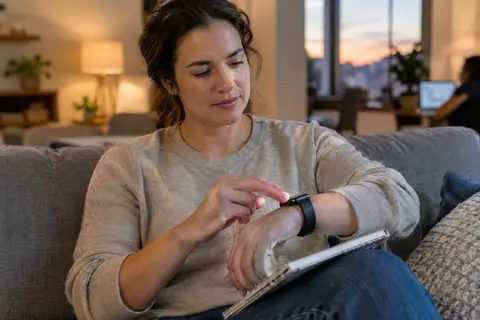
Your pulse, if you can check it or your watch records it
Any medicines or supplements you started recently
MedlinePlus advises contacting a provider if you often feel extra beats (more than 6 per minute or in groups of 3 or more), have a resting pulse over 100 without exercise, anxiety or fever, or have palpitations for the first time.
How to prepare for your EKG
Read moreClose
Wear a two-piece outfit so the chest can be reached easily.
Skip body lotion or oil on your chest that day so the pads stick well.
Bring a list of all medicines and supplements.
Bring a copy of an old EKG if you have one, for comparison.
No. The pads only record signals. Removing them may feel like pulling off a bandage.
Do I need to prepare?
Usually not. Wear a top that is easy to open or remove, and tell us about your medicines and supplements.
Can I come to urgent care for chest pain?
No. Chest pain can be a heart attack. Call 911 so treatment can begin on the way to the hospital.
Can I get an EKG for a work physical?
EKGs can be part of physical exams and non-DOT pre-employment screening. Bring any forms from your employer.
What is the difference between an EKG and an ECG?
There is no difference. Both stand for electrocardiogram. ECG follows the English spelling, while EKG comes from the German word. Both describe the same test that records your heart's electrical signals.
Can an EKG show a blocked artery?
Not directly. An EKG records electrical signals and can show signs of a past or current heart attack, but a normal EKG does not rule out narrowed arteries. Other tests, such as a stress test or imaging, may be needed. Your clinician explains whether follow-up makes sense for you.
Why would I need a Holter monitor after a normal EKG?
A standard EKG records only a short moment. If palpitations or dizziness come and go, they may not happen during the test. NHLBI explains that Holter and event monitors are worn during daily activities to catch rhythms that a brief office test can miss.
Do I need a referral for an EKG?
No outside referral is needed to be seen. A clinician decides whether an EKG fits your symptoms or the form you need completed. Call (630) 324-6825 first to confirm which location offers EKG testing.
“awesome experience here - definitely where i’ll go when in need. super quick and they called me back when they said they would.”
JZ · June 2026 · Google★★★★★
“Fast and very nice and efficient people there. I appreciated their attention to detail.”
J G. · May 2026 · Google★★★★★
“This office was absolutely amazing. The staff was so kind and so patient with me. I become very anxious when physical pain or discomfort is happening due to some personal quirks, and everyone was very kind and supportive and just made me feel safe and answered all my questions and concerns. Thank you so much!”