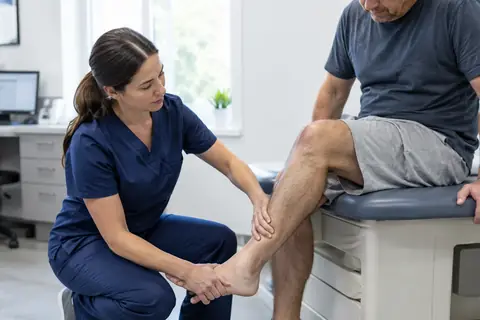
A red, swollen, very painful joint can be a gout flare. Urgent Care Center of Westmont evaluates joint pain at our Westmont, IL clinic, runs lab tests when needed and builds a plan to ease the flare.
Gout is a painful type of arthritis. It happens when too much uric acid builds up in the body and forms crystals in a joint. Flares often start suddenly, sometimes at night, and most often hit the big toe. Urgent Care Center of Westmont, also known as Immediate Care Center of Westmont, evaluates and treats gout flares. Our team is led by board-certified physicians.
Walk in or check in online at our Westmont, IL clinic when a joint suddenly becomes hot, red and swollen.
Key facts
Gout often moves through stages: high uric acid without symptoms, flares, quiet periods between flares and, without treatment, lumps called tophi (NIAMS).
Colchicine, one flare medicine, is most effective when started early in a flare (NIAMS).
A high uric acid level does not always mean gout; many people with high levels never have symptoms (MedlinePlus).
Ice, raising the limb and resting the joint can ease a flare at home.
Gout Symptoms and Risk Factors
The CDC and MedlinePlus describe gout flares as:
Intense pain, often bad enough to wake you up
Swelling, redness and warmth in one joint
Flares that last days to a week or two, then calm down
Risk is higher in men and in people with a family history of gout, obesity, high blood pressure, heart failure, diabetes or kidney problems. Alcohol (especially beer), sugary drinks, red meat, organ meats, some seafood and certain water pills can raise uric acid.
How We Evaluate and Treat Gout at Our Westmont, IL Clinic
Your clinician examines the joint and asks about your history, diet and medicines. We can run on-site lab tests, such as a uric acid level, to help confirm gout and rule out other causes. If a fracture or joint damage is a concern, X-ray imaging is available at our main clinic on Cass Ave.
Treatment focuses on easing the flare. Options can include anti-inflammatory medicines, rest and icing the joint. We also talk about steps that can help prevent future flares, such as limiting alcohol and purine-rich foods, staying active and managing weight. Long-term uric acid control is usually managed with your primary care doctor.
When Joint Pain Needs Emergency Care
Read moreClose
A hot, swollen joint with fever or chills can be a sign of a joint infection, which needs urgent care. Call 911 or go to the nearest emergency room for:
Joint pain with high fever, chills or feeling very ill
Adults come to us for joint pain from Darien, IL, Burr Ridge, IL, Oakbrook Terrace, IL, Woodridge, IL and Hinsdale, IL. Burr Ridge is about 4.4 miles southeast of our Cass Ave clinic (straight-line). We are open Mon–Fri 9 AM–6 PM and Sat–Sun 9 AM–5 PM at both Westmont, IL locations.
Cost, Insurance and Self-Pay
Read moreClose
Most major plans are accepted, including Blue Cross Blue Shield, Cigna, Humana, UnitedHealthcare, Medicare, USAMCO and State of Illinois Benefit Plans. Call (630) 324-6825 to confirm. See our insurance and cost page for details, or our self-pay urgent care pricing, with general visits from $125.
What happens at your visit
Read moreClose
Look at the jointYour clinician checks swelling, warmth, redness and how far the joint can move.
Ask about your historyPast flares, family history, alcohol, diet and medicines such as water pills all matter.
Lab testsA blood uric acid level and other lab tests help confirm gout and rule out other causes. Testing fluid from the joint for crystals may be done by a specialist.
Imaging if neededIf a fracture or joint damage is a concern, X-ray is available at our 29 N Cass Ave clinic only.
Treatment planYou get a plan to calm the flare, which may include prescription medicine when appropriate, and advice on preventing the next one.
Yes. The big toe is most common, but the CDC notes any joint can be affected.
Will changing my diet stop gout?
Diet changes can help lower the risk of flares, but some people also need long-term medicine. Talk with your doctor.
Is a gout flare an emergency?
Usually not, but joint pain with fever needs prompt care to rule out infection.
Do I need an appointment?
No. Walk in or check in online .
What foods trigger gout?
NIAMS lists alcohol, including nonalcoholic beer, sugar-sweetened drinks, red and organ meats and certain seafood as things to limit. A diet high in purine-rich foods, mostly from animal sources, raises the risk. Diet changes help, but some people also need medicine to keep uric acid down.
Should I use ice or heat on a gout flare?
Ice. NIAMS suggests applying ice, raising the limb if you can and resting the joint during a flare. Wrap the ice in a thin cloth and use it in short sessions to protect your skin.
Can I walk on a foot with gout?
You can, but it may hurt, and resting the joint helps the flare settle. Wear loose, soft shoes or sandals that do not press on the toe. If you cannot put weight on the foot, or the pain started after an injury, get it checked to rule out a fracture.
Is high uric acid the same as gout?
No. MedlinePlus notes that many people have high uric acid without any health problems. Gout happens when uric acid forms crystals in a joint and causes flares. Your clinician uses your symptoms, exam and tests together to make the diagnosis.
“These guys were great. Easy check in. Gave me water so I could do urine sample. Were helpful explaining cold sores. Stayed w my mom who has memory issues while I had to leave the room. All that & in & out quick.”
Don G. · September 2025 · Google★★★★★
“Fast service! Really nice people. They took care of my concerns, gave me options for treatment and follow up!”
Ana D. · December 2024 · Google★★★★★
“I rarely go to walk-in clinics but am traveling and needed to be seen. They were excellent here….efficient, polite, professional and knowledgeable. I highly recommend this clinic.”