A sprain is a stretched or torn ligament, and a strain is an injury to a muscle or tendon. Most heal with rest, ice, compression and gentle movement. Urgent Care Center of Westmont examines the injury, takes an X-ray at our Cass Ave clinic when a break is possible, and plans your recovery.
Sprains injure ligaments, which hold bones together at a joint. Strains injure muscles or tendons.
Ankles, knees and wrists are the most common places to sprain. Hamstrings and the back are common places to strain.
MedlinePlus says a mild sprain usually heals in about 7 to 10 days. Most ankle sprains resolve in 2 to 6 weeks.
If you cannot take four steps on an injured ankle, doctors use that as one sign an X-ray is needed.
Our on-site X-ray is at 29 N Cass Ave only, so go there if you think a bone could be broken.
How we treat sprains and strains at our Westmont, IL clinic
Urgent Care Center of Westmont, also known as Immediate Care Center of Westmont, treats twisted ankles, jammed fingers, sore wrists and pulled muscles seven days a week. Our team is led by board-certified physicians. If there is any chance of a broken bone, come to our main clinic at 29 N Cass Ave, Ste A, which has on-site X-ray. Our clinic inside Jewel-Osco does not.
ExamYour clinician asks how you got hurt and checks swelling, bruising, tenderness, movement, feeling and blood flow below the injury.
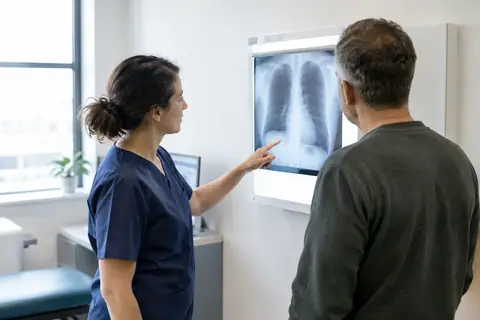
X-ray when neededIf a fracture is possible, your clinician orders an X-ray at our Cass Ave clinic and explains what the images show.
Protect the jointDepending on the injury, your clinician may recommend a wrap, brace, splint or crutches, plus advice on pain control.
Recovery planYou leave with home-care steps, a timeline and signs that mean you need follow-up. Severe injuries may need a specialist or physical therapy, and your clinician will explain why.
Pain, swelling, bruising, trouble moving the joint
You may feel a pop when it happens
Strain (muscle or tendon)
Tendons connect muscle to bone
Common in the back, hamstring and groin
From a twist, pull or repeated motion
Pain, muscle spasms, swelling, weakness
Can happen suddenly or build over time
These descriptions come from MedlinePlus and the NIH's National Institute of Arthritis and Musculoskeletal and Skin Diseases (NIAMS). Both injuries range from a mild stretch to a partial or complete tear.
Is it sprained or broken? When you need an X-ray
Read moreClose
A bad sprain and a broken bone can look and feel the same. Doctors often use the Ottawa ankle rules, described in the journal American Family Physician, to decide who needs an X-ray after an ankle or foot injury:
Pain near the ankle bones, plus tenderness at the back edge or tip of either ankle bone
Pain in the middle of the foot, plus tenderness at the outer edge of the foot or the bone on the inner arch
Not being able to take four steps right after the injury and at the exam
NIAMS explains that sprains are graded from first to third degree, based on how badly the ligament is stretched or torn.
Sprain grades (general guide)
Grade
What happened to the ligament
What you may notice
First degree (mild)
Stretched, with tiny tears
Mild pain and swelling. You can usually walk.
Second degree (moderate)
Partly torn
More swelling and bruising. The joint feels weak or loose.
Third degree (severe)
Completely torn
Major swelling and bruising. Hard or impossible to bear weight.
Pain that is mostly in the muscle, with spasms or weakness when you use it, points more toward a strain. See our twisted ankle, wrist or knee guide for more help sorting out joint pain.
Home care: rest, ice, compression and raising the limb
Read moreClose
NIAMS says many sprains and strains can be treated at home with R.I.C.E. MedlinePlus explains each step:
Rest: avoid putting stress on the injury for the first few days.
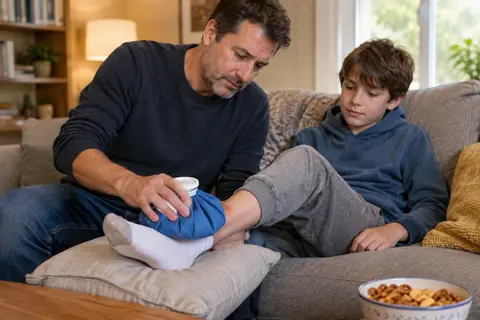
Ice: apply ice wrapped in a cloth, never directly on skin. American Family Physician notes that cold therapy in the first 3 to 7 days reduces pain and speeds recovery.
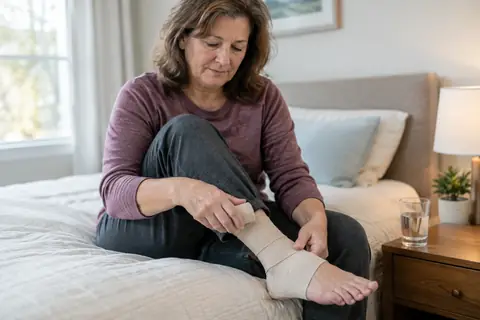
Compression: wrap the area firmly but not tightly. Loosen it if your toes or fingers tingle or turn pale.
Elevation: keep the injured limb raised above the level of your heart, even while sleeping.
Pain relief: ibuprofen or acetaminophen can help when taken as the label directs. Do not give aspirin to children.
Gentle movement helps. Research summarized in American Family Physician found that walking on a mild ankle sprain as soon as pain allows, with a brace or support, leads to faster recovery than long rest.
How long does a sprained ankle take to heal?
Read moreClose
Typical healing times for sprains
Injury
Typical recovery
Source
Mild sprain
About 7 to 10 days
MedlinePlus
Most ankle sprains
2 to 6 weeks
American Family Physician
Bad sprain
Pain and swelling may take several weeks to settle
MedlinePlus
Severe or repeat sprains
Longer, often with physical therapy
NIAMS
MedlinePlus advises contacting a provider if swelling has not started to improve within 2 days, if you see signs of infection such as red, warm skin or fever, or if pain lasts for several weeks. Swelling can linger longer than pain. Read how long a sprained ankle stays swollen.
Sprains in children, athletes and older adults
Read moreClose
Children and teens: a child's bones are still growing, so a limp or a joint that will not bear weight after a fall should be checked rather than watched. Athletes: American Family Physician notes that a balance and strength training program before returning to sport greatly lowers the risk of another ankle injury. Our sports physicals are a good time to review past injuries.
Older adults: a fall onto an outstretched hand or a twisted ankle can cause a break that looks like a sprain. An X-ray is often the only way to know, so get checked after any fall that leaves pain or swelling.
How to prevent sprains and strains
Read moreClose
NIAMS lists common risk factors such as poor technique, overtraining, ramping up too fast, hard surfaces, unsupportive shoes, poor flexibility and a prior injury. To lower your risk:
Warm up and stretch before sports or yard work.
Increase training time and intensity slowly.
Wear shoes that fit well and support your feet.
Rebuild strength and balance fully after any sprain.
Use salt, good boots and handrails on icy Illinois sidewalks and steps in winter.
Lift with your legs, keep loads close, and ask for help with heavy items.
Cost and insurance for a sprain visit
Read moreClose
We accept most major insurance plans, including Blue Cross Blue Shield, Cigna, Humana, UnitedHealthcare and Medicare. Call (630) 324-6825 to confirm your plan, or see our cost and insurance page. Self-pay general visits start from $125. If you are paying on your own, ask about X-ray costs before imaging is done.
You often cannot tell by looking. Doctors use the Ottawa ankle rules: tenderness at the back edge or tip of the ankle bones, or not being able to take four steps, means an X-ray is needed. Our X-ray is at the 29 N Cass Ave clinic in Westmont, IL.
How long does a sprained ankle take to heal?
MedlinePlus says a mild sprain usually heals in about 7 to 10 days, while a bad sprain can take several weeks. American Family Physician reports that most ankle sprains resolve in 2 to 6 weeks. Swelling often lasts longer than pain.
What is the difference between a sprain and a strain?
A sprain is an injury to a ligament, the tissue that connects two bones at a joint, such as in the ankle or wrist. A strain is an injury to a muscle or tendon, the tissue that connects muscle to bone, such as in the back or hamstring.
Should I walk on a sprained ankle?
For a mild sprain, gentle walking as pain allows, with a brace or support, often helps recovery, according to research in American Family Physician. If you cannot take four steps, or the pain is severe, stay off it and get an X-ray to check for a break.
Can urgent care treat a sprained ankle?
Yes. Our clinicians examine the injury, take an X-ray at our Cass Ave clinic if a break is possible, and recommend protection such as a wrap, brace or crutches. You leave with a home-care plan and signs that mean you need follow-up.
How long should I ice a sprain?
Use ice in the first few days after the injury, wrapped in a cloth so it never touches your skin. Take breaks so the skin can warm back up. American Family Physician notes that cold therapy in the first 3 to 7 days reduces pain and speeds recovery. Ask your clinician how often to ice your injury.
“The staff was very professional Easy to talk to and very knowledgeable. I would recommend. & return 5 ⭐️”
Robert J. · March 2026 · Google★★★★★
“I’ve never been to a clinic with such speed, accuracy, and professionalism. Will absolutely return next sickness. Thanks team!”
Justin P. · February 2026 · Google★★★★★
“Very friendly, professional, and quick. I have been to this location before with a very good experience which is why I returned. Back again today and I cannot say enough about the amazing staff in the clinic. So friendly, happy, courteous, professional, and just so gosh darn pleasant. I highly recommend UC of Westmont!!”