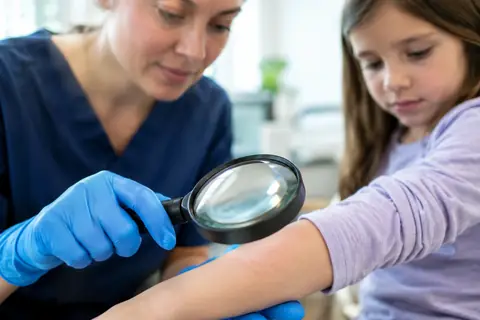
Impetigo care for children and adults at Urgent Care Center of Westmont in Westmont, IL. We check red sores and honey-colored crusts, discuss treatment and explain how to stop it spreading at home and school.
Impetigo is a common, contagious bacterial skin infection. It causes red, itchy sores that ooze and then form honey-colored crusts, most often around the nose and mouth. It is most common in children ages 2 to 5, but anyone can get it. At Urgent Care Center of Westmont in Westmont, IL, also known as Immediate Care Center of Westmont, you can walk in to have sores checked and treated.
The CDC says impetigo is treated with antibiotics, either a cream for a few sores or pills for more widespread infection. Our team, led by board-certified physicians, will recommend the right approach and explain how to keep it from spreading to the rest of the family.
Key facts
With treatment, impetigo is usually no longer contagious within 24 to 48 hours (AAD).
Without treatment, impetigo often clears in 2 to 4 weeks, but it can keep spreading to others in the meantime (AAD).
Impetigo has two main forms: crusted, which forms honey-colored scabs, and bullous, which starts as larger fluid-filled blisters (AAP).
Cleaning any scrape or bug bite with soap and water helps keep the bacteria out.
What impetigo is and common symptoms
Impetigo is caused by group A strep bacteria, staph bacteria, or both. The bacteria often enter through a scrape, insect bite or other break in the skin. MedlinePlus notes that MRSA, a type of staph, is becoming more common as a cause.
Signs to look for
Red, itchy sores, often on the face, lips, arms or legs
Sores or blisters that leak fluid or pus
Honey-colored or yellow crusts
Swollen lymph nodes near the infected area
Impetigo spreads by close contact, especially in homes, daycares and other crowded places. Scratching can move it to other parts of the body. Sores usually heal without scarring.
How we treat impetigo at our Westmont, IL clinic
Impetigo is usually recognized by how the skin looks. The provider will examine the sores and ask how long they have been there. If sores are not healing or MRSA is a concern, they may take a sample to send to the lab.
Treatment depends on how many sores there are and how widespread they are. Follow the plan exactly as prescribed and finish all of it, even when the skin looks better.
Home care and preventing spread
Gently wash the sores with soap and water to remove crusts
Keep the sores loosely covered
Wash hands often, and keep children's nails short
Use separate towels, washcloths and bedding, and wash them after use
Avoid touching or scratching the sores
Return to school or work
The CDC says people can return to school, daycare or work once they have started antibiotic treatment, as long as the sores are covered. Check your school's or daycare's own policy as well.
When to seek emergency or prompt care
Read moreClose
Return for a recheck if sores spread, are not improving with treatment, or come with fever. Get prompt care for red, warm, painful, swelling skin that spreads quickly. Rarely, strep impetigo can lead to kidney problems; the CDC lists this as a rare complication. Seek care for dark or cola-colored urine or swelling of the face or legs.
Call 911 or go to the nearest emergency room for trouble breathing, chest pain, stroke signs, severe bleeding, or a child who is very drowsy or hard to wake.
Walk-ins are welcome at both of our locations: the main clinic at 29 N Cass Ave, Ste A, Westmont, IL 60559, and our second location inside Jewel-Osco at 4 E Ogden Ave, Westmont, IL 60559. Both are open Monday to Friday, 9 AM to 6 PM, and Saturday and Sunday, 9 AM to 5 PM. Call (630) 324-6825, or check in online before you arrive.
We accept most major plans, including Blue Cross Blue Shield (PPO), BCBS Advocate Good Samaritan (HMO), Cigna, Humana, UnitedHealthcare, Medicare, Meridian and CountyCare. Coverage varies, so please call to confirm your plan. Read more on our cost and insurance page.
No insurance? Self-pay patients get flat, upfront pricing, with a general visit from $125. Ask about the price of any tests before they are done. See self-pay urgent care pricing.
Crusted vs. bullous impetigo
Read moreClose
Crusted impetigo (most common)
Starts as tiny blisters that burst
Leaves red, oozing patches
Dries into yellow or honey-colored crusts
Often around the nose and mouth
Bullous impetigo
Starts as larger blisters filled with clear fluid
Blisters may burst and leave moist, red sores
Sores later dry into crusts
Can appear on the body, arms or legs
Both forms are caused by bacteria and are treated the same general way. HealthyChildren.org from the American Academy of Pediatrics describes both.
Impetigo or something else?
Read moreClose
Skin problems that can look like impetigo
Condition
Clues
Impetigo
Oozing sores with honey-colored crusts that spread with scratching
Cold sore
Tingling first, then a cluster of small blisters at the lip edge. See cold sore treatment
Ringworm
A ring-shaped, scaly, itchy patch with a clearer center. See ringworm treatment
Eczema flare
Dry, itchy, rough patches, often in skin folds; can become infected
Insect bites
Itchy bumps, often in groups on uncovered skin; scratching can lead to impetigo
Yes. It spreads through close contact and shared items like towels. Covering sores and washing hands helps prevent spread.
When can my child go back to school?
The CDC says children can return once they have started antibiotic treatment and the sores are covered. Your school may have its own rules.
Does impetigo leave scars?
Usually not. The CDC and MedlinePlus note that sores typically heal without scarring.
Can adults get impetigo?
Yes. It is most common in young children, but adults can get it too, especially after a cut, scrape or insect bite.
How does impetigo start?
Crusted impetigo, the most common type, often starts as tiny blisters that burst and leave red, oozing patches. These dry into yellow or honey-colored crusts. It usually begins around the nose and mouth or at a scrape or bug bite, according to the American Academy of Pediatrics.
Can impetigo go away on its own?
Sometimes. The AAD says untreated impetigo often clears in 2 to 4 weeks. But it stays contagious during that time and can spread to other parts of the body and to other people. Treatment usually stops the spread within 24 to 48 hours.
Can my child play sports with impetigo?
Wait until your child has been treated long enough to no longer be contagious and the sores can be covered. Close-contact sports, such as wrestling, spread skin infections easily, so check with the coach or athletic trainer about their rules before returning.
Can I use an over-the-counter antibiotic ointment for impetigo?
Ask first. The AAD notes impetigo is usually treated with a prescription antibiotic ointment, or pills for more widespread infection. For a fresh scrape that is not infected, cleaning it and using an antibiotic ointment can help prevent infection. Read will Neosporin fight infections?
“They are always so kind and helpful. In and out quickly but not rushed. Myself and my son go.”
Rebecca R. · February 2025 · Google★★★★★
“Follow up on a previous visit. Quick visit with lots of good info about what's going on and what to expect going forward. Friendly and accommodating staff”
Ken B. · August 2024 · Google★★★★★
“I love this center! My 2nd time coming and both times my daughters were seen very fast. Very clean with very nice staff”