Private, walk-in herpes testing at Urgent Care Center of Westmont in Westmont, IL. Swab testing of sores or blood testing for HSV, reviewed by our team led by board-certified physicians.
Genital herpes is a common sexually transmitted infection caused by herpes simplex virus type 1 (HSV-1) or type 2 (HSV-2). Many people with herpes have no symptoms or very mild ones. Urgent Care Center of Westmont, also known as Immediate Care Center of Westmont, offers confidential herpes testing in Westmont, IL, with results explained privately by our team led by board-certified physicians.
If you have a sore, a swab test of the sore is usually the most useful test. If you do not have symptoms, a blood test for HSV antibodies may help in some situations. Your provider will help you decide.
Key facts
For a sore, a NAAT (PCR) swab is the most sensitive herpes test, and testing works less well once a sore starts healing (CDC).
Herpes blood tests can miss a new infection, so CDC suggests repeating the test 12 weeks after a possible exposure.
Low-positive results on some herpes blood tests can be false positives and need a second test to confirm (CDC).
Daily suppressive medicine can cut outbreaks by 70% to 80% in people who have them often (CDC).
Everyone diagnosed with genital herpes should also be offered an HIV test.
Herpes symptoms and how it spreads
According to the CDC, herpes can cause blisters on or around the genitals, rectum or mouth. The blisters break and leave painful sores that may take a week or more to heal. A first outbreak may come with flu-like symptoms such as fever or body aches. Later outbreaks are usually shorter and milder.
Herpes spreads through vaginal, anal or oral sex and skin-to-skin contact. It can spread even when no sores are visible, and many people do not know they have it. It does not spread through toilet seats, bedding or swimming pools.
HSV-1 often causes oral herpes (cold sores), but it can also cause genital herpes through oral sex.
How herpes testing works at our Westmont, IL clinic
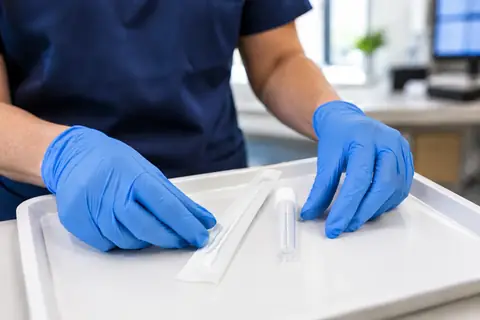
You meet privately with a provider who asks about symptoms and your sexual health history. If a sore is present, the provider looks at it and may take a gentle swab to test for the virus. Testing works best when the sore is fresh, so come in soon after it appears.
Blood tests look for antibodies to HSV-1 and HSV-2. The CDC notes that a blood test can show whether you have a herpes infection, but it cannot tell you who gave it to you or when you got it. The CDC does not recommend routine herpes blood testing for everyone, so your provider will explain whether it is useful for you.
There is no cure for herpes, but it can be treated. Antiviral medicine can shorten or prevent outbreaks and lower the chance of passing the virus to a partner. Your provider reviews results with you and talks about treatment, prevention and whether other STD tests make sense.
When to seek emergency care
Read moreClose
Go to the nearest emergency room for severe headache with a stiff neck and fever, new confusion, or eye pain with vision changes. Pregnant patients with a new outbreak near delivery should contact their obstetric provider right away.
Call 911 or go to the nearest emergency room for chest pain or pressure, severe trouble breathing, sudden weakness or drooping on one side of the face or body, sudden trouble speaking or seeing, fainting or severe confusion, a seizure, or heavy bleeding.
Most major insurance plans are accepted, including Blue Cross Blue Shield, Cigna, Humana, UnitedHealthcare, Medicare, Meridian and CountyCare. Plans change, so call (630) 324-6825 to confirm your coverage. See the full list on our cost and insurance page.
Paying on your own? Our self-pay urgent care pricing is flat and upfront, with a general visit from $125. Lab tests may add to the cost; we will tell you before anything is ordered.
Both of our locations are open Monday to Friday, 9 AM to 6 PM, and Saturday and Sunday, 9 AM to 5 PM. The main clinic is at 29 N Cass Ave, Ste A, Westmont, IL 60559. Our second location, inside Jewel-Osco, is at 4 E Ogden Ave, Westmont, IL 60559. No appointment is needed. You can also check in online.
What happens at your visit
Read moreClose
Come in earlyIf you have a sore, walk in or check in online while it is fresh. Testing is more accurate before it heals.
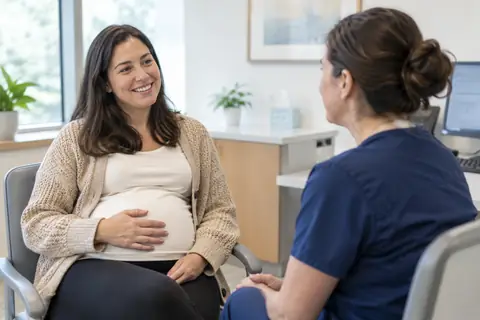
Private conversationYour clinician asks about symptoms, past outbreaks and your sexual health history, one-on-one and without judgment.
The right testA gentle swab of the sore, or a type-specific blood test if there is nothing to swab and testing makes sense for you.
Results and planYour clinician explains what the result can and cannot tell you, talks through treatment and offers other STD tests, including HIV.
Swab test vs. blood test
Read moreClose
Swab of a sore (NAAT or PCR)
Used when you have a blister or open sore
The most sensitive test for an active sore
Can show whether the virus is HSV-1 or HSV-2
Less accurate on healing sores, so come in early
Blood test (type-specific antibodies)
Used when there is no sore to swab
Shows past exposure to HSV-1 or HSV-2
Can miss a recent infection; repeat at 12 weeks
Low-positive results may need a confirming test
Cannot show where on the body or when you were infected
CDC does not recommend routine herpes blood testing for people without symptoms, so your clinician explains whether a blood test will help in your case.
Living well with herpes
Read moreClose
Herpes is very common, and many people with it have healthy relationships. Outbreaks often become shorter and milder over time, and treatment helps.
Daily suppressive medicine can reduce outbreaks by 70% to 80% in people who have them often, according to CDC.
Treatment for each outbreak works when started within a day of a sore or at the first tingle.
Lowering the risk for a partner: CDC notes daily valacyclovir reduces HSV-2 spread in couples, and condoms lower the risk further, though neither removes it completely.
Timing matters: avoid sex during an outbreak and when you feel early warning signs.
If you are pregnant or planning a pregnancy, tell your prenatal provider about any history of herpes, yours or a partner's. CDC notes the risk to a newborn is highest when the infection is first caught near delivery.
For people with known herpes, CDC says daily suppressive medicine starting at 36 weeks of pregnancy lowers the chance of an outbreak at delivery. Your prenatal provider will guide that plan.
Can I be tested if I do not have a sore right now?
Yes, a blood test can look for HSV antibodies. It cannot show where an infection is or when it started, so your provider will explain what a result would and would not tell you.
Can herpes spread without symptoms?
Yes. The CDC says herpes can spread even when there are no visible sores. Condoms lower the risk but do not remove it fully.
Is herpes curable?
No. The virus stays in the body, but treatment can reduce outbreaks and lower the chance of spreading it.
Is my visit private?
Yes. You speak with your provider one-on-one, and results are shared only with you. Walk in or check in online for herpes testing .
How long after exposure will herpes show up on a blood test?
Antibodies take time to form, so an early blood test can be negative even if you were infected. CDC suggests repeating a type-specific blood test 12 weeks after a possible exposure if the first one is negative. If you develop a sore, a swab of the sore is a more direct test.
Is herpes included in a standard STD panel?
Often not. CDC does not recommend routine herpes blood testing for people without symptoms, so many panels leave it out. If you have a sore or a specific concern, ask about herpes testing by name. See what does an STD panel include?
What does a low-positive HSV-2 blood test mean?
CDC notes that some common herpes blood tests give false positives at low index values, roughly 1.1 to 3.0. A result in that range should be confirmed with a second, different test before you accept a diagnosis. Your clinician can explain your exact number.
Can medicine keep me from giving herpes to my partner?
It lowers the risk but does not remove it. CDC notes that daily valacyclovir reduces HSV-2 spread in couples where one partner has it. Using condoms and avoiding sex during outbreaks or early warning signs lower the risk further.
“awesome experience here - definitely where i’ll go when in need. super quick and they called me back when they said they would.”
JZ · June 2026 · Google★★★★★
“Fast and very nice and efficient people there. I appreciated their attention to detail.”
J G. · May 2026 · Google★★★★★
“This office was absolutely amazing. The staff was so kind and so patient with me. I become very anxious when physical pain or discomfort is happening due to some personal quirks, and everyone was very kind and supportive and just made me feel safe and answered all my questions and concerns. Thank you so much!”