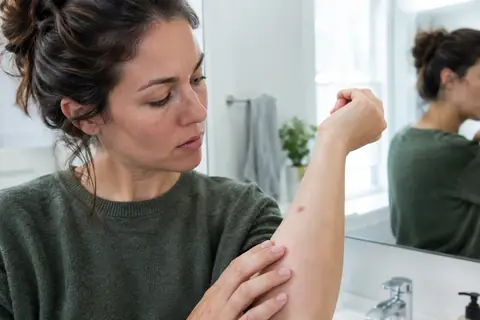
Tick bite treatment and Lyme disease risk in Westmont, IL
Remove an attached tick right away with fine-tipped tweezers, pulling straight out. Then watch for a rash or fever for several weeks. Urgent Care Center of Westmont checks tick bites, looks for parts left in the skin and explains whether a preventive antibiotic for Lyme disease makes sense for you.
Remove a tick as soon as possible. The CDC says not to wait for a healthcare provider.
Grasp the tick close to the skin and pull straight out with steady pressure. Do not twist, burn or smother it.
IDPH says the Lyme rash appears in about 70 to 80 percent of cases, usually 3 to 32 days after the bite.
Ticks are most active from April through September, but bites can happen any time of year.
A small red bump that appears within 72 hours and fades in a few days is usually a reaction to the bite, not Lyme disease.
How we care for tick bites at our Westmont, IL clinic
Urgent Care Center of Westmont, also known as Immediate Care Center of Westmont, sees children and adults after tick bites seven days a week. Our team is led by board-certified physicians. Walk in to either Westmont, IL clinic or check in online.
Bring the tick if you saved itA tick sealed in a bag, wrapped in tape or placed in rubbing alcohol helps your clinician see what type it is and how full of blood it was.
Check the biteYour clinician looks at the bite and nearby skin, checks for tick parts left behind, and asks when and where you were bitten. Help with parts stuck in the skin is similar to our foreign body removal care.
Review your Lyme riskYour clinician considers the type of tick, how long it was attached and how long ago it was removed.
Recommend next stepsYour clinician can recommend treatment, which may include a preventive dose of prescription medicine when appropriate, plus a plan for what to watch.
If a rash or fever shows up in the weeks after a bite, come back. Your clinician will examine the rash and may order lab tests when they will help.
How to remove a tick safely
The CDC recommends these steps. Fine-tipped tweezers work well, but regular tweezers or clean fingers can work too.
Grasp the tick as close to the skin as you can, without squeezing its body.
Pull straight up with steady, even pressure. Do not twist or jerk.
If mouthparts stay in the skin, try to remove them with tweezers. If they will not come out easily, leave them. Your skin will usually push them out as it heals.
Clean the bite and your hands with soap and water, rubbing alcohol or hand sanitizer.
Get rid of a live tick by sealing it in a bag or container, wrapping it tightly in tape, flushing it, or putting it in alcohol. Never crush it with your fingers.
Check your whole body for other ticks.
Skip petroleum jelly, nail polish, matches or heat. The CDC warns these can make the tick push more fluid into your skin.
Ticks and Lyme disease in Illinois
Read moreClose
Lyme disease is spread by infected blacklegged ticks, also called deer ticks. The CDC says it is most common in the Northeast, mid-Atlantic and upper Midwest. IDPH confirms that infected deer ticks have been found in Illinois. Young ticks are about the size of a pinhead, so many people never see the one that bit them.
Not every tick carries disease, and you cannot tell an infected tick by looking at it. Ticks live in wooded areas, brush and tall grass. In DuPage County, that includes forest preserve trails, parks and overgrown backyards. The CDC says ticks are most active from April through September.
The CDC does not recommend sending a tick for testing, because the results are not reliable for treatment decisions. What matters most is your symptoms and how long the tick was attached.
Tick bite symptoms: normal reaction or Lyme disease?
Read moreClose
Usually a normal bite reaction
Starts within 72 hours of the bite
Small, under about 2 inches across
May itch or be a little sore
Fades within a few days
Possible Lyme disease
Rash appears 3 to 32 days after the bite
Grows larger over days, often clearing in the middle
Usually not painful
May come with fever, chills, tiredness, headache, swollen glands, or muscle and joint aches
This comparison comes from IDPH. Not everyone with Lyme disease gets a rash. Fever, headache or body aches in the weeks after a tick bite are worth a visit, even without a rash. See our rash symptom guide for other causes of rashes.
Do I need antibiotics after a tick bite?
Read moreClose
Most tick bites do not need antibiotics. The CDC says a preventive antibiotic might help after some bites, depending on the type of tick and how long it was attached. CDC guidance for clinicians describes a single preventive dose for certain deer tick bites when it can be started within 72 hours of removing the tick.
If Lyme disease does develop, IDPH says early antibiotic treatment usually leads to a fast and complete recovery. The CDC notes that most cases are treated successfully with a few weeks of antibiotics. Without treatment, the infection can spread to the joints, heart and nervous system.
What to watch for after a tick bite
Read moreClose
Tick bite timeline (based on CDC and IDPH)
Time after removal
What to know
What to do
First 72 hours
A small red bump at the bite is common.
If the tick was attached a long time, ask about preventive treatment within this window.
3 to 32 days
The window when a Lyme rash usually appears.
Check the bite and skin daily. Photograph any rash.
Several weeks
Fever or rash can still develop.
See a clinician for rash or fever, and tell them about the bite.
Weeks to months
Untreated Lyme can cause joint, heart or nerve problems.
Get checked for new joint swelling, facial weakness or heart symptoms.
When you see a clinician, the CDC suggests sharing three things: that you had a tick bite, when it happened, and where you most likely picked up the tick.
Tick bites in children and pets
Read moreClose
Children play close to the ground and in grass, so they pick up ticks often. IDPH advises checking yourself, children and pets every two to three hours while outdoors in tick areas. The CDC recommends checking under the arms, in and around the ears, inside the belly button, behind the knees, in the hair, between the legs and around the waist.
Dogs and cats can carry ticks into the house, so check pets, coats and backpacks too. If your child has a tick bite with a new rash or fever, our pediatric urgent care team can help.
How to prevent tick bites in DuPage County
Read moreClose
Use an EPA-registered insect repellent with DEET, picaridin, IR3535, oil of lemon eucalyptus, PMD or 2-undecanone, following the label.
Treat clothing, boots and gear with 0.5% permethrin, or buy pretreated items. Do not put permethrin on skin.
Wear light-colored clothing, and tuck pant legs into socks.
Walk in the center of trails, away from tall grass and brush.
Shower within two hours of coming inside.
Tumble dry outdoor clothes on high heat for 10 minutes to kill ticks.
We accept most major insurance plans, including Blue Cross Blue Shield, Cigna, Humana, UnitedHealthcare and Medicare. Call (630) 324-6825 to confirm your plan, or visit our cost and insurance page. Self-pay general visits start from $125.
Use fine-tipped tweezers to grasp the tick as close to the skin as possible. Pull straight up with steady, even pressure, without twisting. Clean the bite and your hands afterward. Do not use petroleum jelly, nail polish or heat, which the CDC says can make things worse.
What does a Lyme disease rash look like?
IDPH describes a circular rash that often looks like a bull's-eye and grows larger over days or weeks. It usually is not painful and often clears in the center. It typically appears 3 to 32 days after the bite. A small red bump that shows up within 72 hours and fades is usually just a bite reaction.
Should I see a doctor after a tick bite?
Most tick bites do not need a visit if you removed the whole tick and feel well. Get checked if you cannot remove it, if it was attached a long time, or if you develop a rash or fever in the following weeks. A clinician can also discuss preventive treatment within 72 hours of removal.
Do ticks in Illinois carry Lyme disease?
Some do. IDPH reports that infected deer ticks have been found in Illinois, and the CDC lists the upper Midwest among the areas where Lyme disease is most common. Most ticks are not infected, but you cannot tell by looking, so prevention and quick removal matter.
What happens if part of the tick is left in my skin?
The CDC says to try removing leftover mouthparts with tweezers, but if they do not come out easily, leave them alone. Your skin will usually push them out as it heals. Keep the area clean, and get it checked if it becomes red, swollen or painful.
When are ticks most active in Illinois?
The CDC says ticks are most active in warmer months, from April through September, though bites can happen year-round. Spring and summer hikes, yard work and play in tall grass bring the most risk. Check for ticks after any time outdoors in wooded or grassy areas.
“Very prompt, very knowledgeable and very kind and informative too. Excellent care by Mattie and Kelly!!!”
Tim G. · May 2026 · Google★★★★★
“I had a laceration that was stitched in ten minutes and was out of there in thirty minutes! No pain the next day. Meds are working! Professional staff all around.”
Jack M. · March 2026 · Google★★★★★
“It was a great visit Yesenia was so nice and made me feel Comfortable after waiting a hour she seen I was still there and called me in right away What a Beautiful Soul”