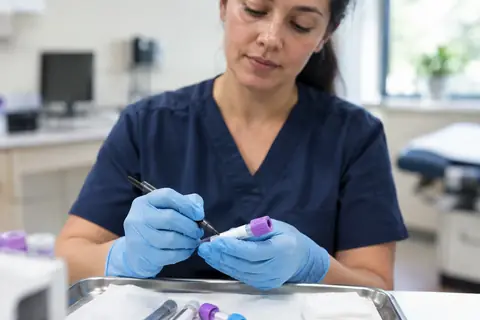
Allergy blood testing at Urgent Care Center of Westmont in Westmont, IL. Our team, led by board-certified physicians, reviews your symptoms, tests for common triggers and explains what results mean.
An allergy blood test measures IgE antibodies, proteins your immune system makes when it reacts to a trigger such as pollen, dust mites, mold, pet dander or certain foods. Urgent Care Center of Westmont, also known as Immediate Care Center of Westmont, offers allergy blood testing in Westmont, IL, together with a full review of your symptoms by our team led by board-certified physicians.
Testing can help explain sneezing, itchy eyes, hives or other symptoms that keep coming back. Results are one piece of the picture, so your provider reads them alongside your history.
Key facts
Tree pollen usually starts allergy season in early spring, grasses follow in late spring and summer, and ragweed blooms from August to November (ACAAI).
Medicines such as antihistamines do not interfere with allergy blood tests, according to ACAAI.
Allergy test results do not diagnose an allergy on their own; they are read together with your history and symptoms.
Showering and changing clothes after time outdoors cuts how much pollen you carry into your home.
Allergy symptoms and common triggers
MedlinePlus lists common allergy symptoms as a runny nose, sneezing, itching, rashes, swelling or asthma. Reactions range from mild to severe.
Frequent triggers include:
Tree, grass and weed pollen
Dust mites
Mold spores
Pet dander
Foods such as nuts and shellfish
Insect stings
Certain medicines
Seasonal patterns can be a clue. Symptoms that flare in spring or late summer often point to pollen, while year-round symptoms may point to dust mites, mold or pets.
How allergy testing works at our Westmont, IL clinic
Your visit starts with questions about when symptoms happen, what seems to set them off, and what you have tried. Your provider then decides whether a blood test makes sense and which allergens to check.
The test uses a standard blood draw. A total IgE test measures overall antibody levels, and specific IgE tests look at reactions to individual allergens. No special preparation is usually needed, but tell your provider about all medicines you take, especially antihistamines.
A positive result does not always mean you will react in daily life. MedlinePlus notes that false positives can happen, while false negatives are uncommon. Your provider explains your results, offers ways to reduce exposure to your triggers, and talks through treatment options. If you may benefit from skin testing or allergy shots, we can refer you to an allergist.
When an allergic reaction is an emergency
Read moreClose
Anaphylaxis is a severe allergic reaction that can be life-threatening. Call 911 right away for trouble breathing or wheezing, swelling of the face, lips, tongue or throat, throat tightness, dizziness or fainting, especially after a food, medicine or insect sting. Use an epinephrine auto-injector if one has been prescribed to you.
Call 911 or go to the nearest emergency room for chest pain or pressure, severe trouble breathing, sudden weakness or drooping on one side of the face or body, sudden trouble speaking or seeing, fainting or severe confusion, a seizure, or heavy bleeding.
We work with most major plans, from Blue Cross Blue Shield to Medicare, CountyCare and State of Illinois Benefit Plans. The full list is on our cost and insurance page. Please call (630) 324-6825 to confirm your plan before your visit.
For patients without insurance, we post self-pay urgent care pricing: a general visit starts at $125, with any extra tests explained up front.
Both of our locations are open Monday to Friday, 9 AM to 6 PM, and Saturday and Sunday, 9 AM to 5 PM. The main clinic is at 29 N Cass Ave, Ste A, Westmont, IL 60559. Our second location, inside Jewel-Osco, is at 4 E Ogden Ave, Westmont, IL 60559. Walk-ins are welcome, or check in online before you leave home.
What happens at your allergy testing visit
Read moreClose
Before you comeJot down when symptoms happen, where you are when they start and which medicines help. Photos of any hives or rash are useful.
History and examYour clinician asks about your home, pets, work, hobbies and family history, then checks your nose, eyes, throat, lungs and skin.
Choosing the testIf testing makes sense, the clinician picks allergens that match your story rather than a long, random list.
Blood drawA small blood sample is taken from your arm. You can usually keep taking your allergy medicine, since medicines do not affect this test.
Results and next stepsYour clinician explains each result, how to cut exposure to your triggers and when an allergist visit makes sense.
Walk in to our Westmont, IL clinic or check in online before you leave home.
Allergy blood test vs. skin prick test
Read moreClose
Blood test (IgE)
One needle stick for a blood sample
Antihistamines and other medicines do not interfere
A good option with widespread rash or when you cannot stop certain medicines
False positives can happen, so results need context
Offered at Urgent Care Center of Westmont
Skin prick test
Tiny amounts of allergens are pricked into the skin
ACAAI calls it the gold standard and usually the most accurate
Antihistamines must be stopped about 3 to 7 days before
Done in an allergist's office
Ask us for a referral if you need it
Both tests show whether your immune system is sensitized to a trigger. ACAAI notes that a positive test does not always mean you will react to that trigger in daily life.
Allergy seasons around Westmont, IL
Read moreClose
Typical allergy triggers by season (ACAAI)
Time of year
Main trigger
What helps
Early spring, often from February
Tree pollen
Keep windows closed; tree pollen tends to peak in the evening
Late spring and summer
Grass pollen
Shower and change clothes after mowing or outdoor sports
August to November
Ragweed and other weeds
Ragweed often peaks in early to mid-September and is highest in the morning
Warm, humid or rainy stretches
Outdoor mold
A rainy spring can stretch symptoms into fall
All year
Dust mites, pet dander, indoor mold
Clean bedding often and keep pets out of the bedroom
Matching your worst weeks to this calendar helps your clinician choose which allergens to test. Our allergy symptoms guide and sinus pressure guide cover common symptoms in more detail.
Simple ways to cut your exposure
Read moreClose
Check pollen and mold counts in the weather report during allergy season.
Keep windows closed at home and in the car on high-pollen days.
Shower, wash your hair and change clothes after yard work or outdoor play.
Wear an N95 mask when mowing or raking, and take any recommended medicine before you start.
If pets trigger symptoms, keep them out of the bedroom.
Do I need to stop my allergy medicine before testing?
For a blood test, usually not, but tell your provider about every medicine you take, especially antihistamines. They will tell you if anything should change.
Is a blood test as good as a skin test?
Both are standard ways to test for allergies. A blood test can be a good choice for people who cannot stop certain medicines or who have skin conditions. An allergist can advise on skin testing.
Can allergy testing find a food allergy?
It can show antibodies to certain foods, but a positive result alone does not prove a food allergy. Your history of reactions matters most.
Do I need an appointment?
No. Walk in, or check in online for allergy testing .
Can urgent care do allergy testing?
Yes. At Urgent Care Center of Westmont, our clinicians review your symptoms and can order an allergy blood test for common triggers such as pollen, dust mites, mold and pet dander. If you need skin testing or allergy shots, we can refer you to an allergist.
How accurate are allergy blood tests?
They are useful but not perfect. ACAAI notes that false positives can happen and that test results alone do not diagnose an allergy. Your clinician reads the results together with when and where your symptoms happen, so a careful history matters as much as the test itself.
Is it allergies or a cold?
Colds often bring a sore throat, body aches or a low fever and usually get better within a week or two. Allergies tend to cause itchy eyes, sneezing and a clear, runny nose that lasts as long as you are around the trigger, often returning at the same time each year. If you are not sure, an exam can help.
When should I get tested for seasonal allergies?
A blood test can be done any time of year, since allergy medicine does not affect it. Many people come in during their worst season, when it is easier to connect symptoms to a trigger. Bring notes on when your symptoms start and stop.